Search
381-400 of 465 results with category "Orthopedics"
Evaluation of Potential Intra-Articular Joint Lacerations
Skin and soft tissue injuries in proximity to a joint often prompt concern of whether the injury violated the joint space. Joint Space involvement is important to exclude as it can lead to septic joints and long term disability.
One easy way to determine if the joint capsule has been violated is to inject methylene blue into the joint and watch to see if any of the methylene blue extravasates through the soft tissue.
Indications for a methylene blue injection include:
- Periarticular fracture
- Visible joint capsule
- Proximity to a joint
There are no absolute contraindications. Though clearly the procedure does not need to be done when the injury highly suggests an open joint injury and the patient will require operative debridement and exploration.
To watch a video of a injection head to eMedicine by clicking http://emedicine.medscape.com/article/114453-overview
Show References
Transverse Myelitis
A group of inflammatory disorders characterized by acute or subacute motor weakness, sensory abnormalities and autonomic (bowel, bladder, sexual) cord dysfunction.
Symptoms are usually bilateral but both unilateral and asymmetric presentations can occur.
Look for a well-defined truncal sensory level
-below which sensation of pain and temperature is altered or lost.
Causes: Autoimmune after infection or vaccination (60% of cases in children), direct infection, or a demyelinating disease such as MS. No cause is found in 15 – 30% of cases.
Incidence: Bimodal peak at 10-19 years and at 30-39 years.
Diagnostic testing: MRI of the ENTIRE spine to both rule out structural lesions and rule in an intrinsic cord lesion. If MRI is normal reconsider the original diagnosis.
Treatment: Steroids are first-line therapy. Dosing is controversial but generally involves high IV doses for 3-5 days (1000 mg methylprednisolone). Plasma exchange is second line for those who don’t respond to steroids.
Show References
Risk Factors for Spinal Epidural Abscesses
Building on Dr. Corwell's pearl from last week concerning Spinal Epidural Abscess, risk factors for Spinal Epidural Abscesses other than IV drug abuse are:
- Diabetes
- ESRD
- Septicemia
- HIV infection
- Malignancy
- Morbid obesity
- Long-term corticosteroid use
- Alcoholism
- Infection at a distal site
- Indwelling catheters
- Spinal surgery
The infection can occur via three routes 1) hematogenous spread 2) Direct Extension from a local infection such as osteoomyelitis, and 3) iatrogenic introduction which is thought to be responsible for 14-22% of the cases. A catheter in the epidural space for more than 2 days has a infection rate of 4.3%.
Show References
Epidural compression syndrome encompasses spinal cord compression, cauda equina syndrome, & conus medullaris syndrome.
Causes include:
- massive midline disc herniation (most commonly), usually at the L4 to L5 level.
- tumor
- epidural abscess
- spinal canal hematoma.
Measurement of a post-void bladder residual volume tests for the presence of urinary retention with overflow incontinence (a common, though late finding) (sensitivity of 90%, specificity of 95%). Large post-void residual volumes (>100 mL) indicate a denervated bladder with resultant overflow incontinence and suggest significant neurologic compromise. The probability of cauda equina syndrome in patients without urinary retention is approximately 1 in 10,000.
Use this in your daily practice!!
The administration of glucocorticoids can minimize ongoing neurologic damage from compression & edema until definitive therapy can be initiated. The optimal initial dose and duration of therapy is controversial, with a recommended dose range of dexamethasone anywhere from 10 to 100 mg intravenously. Consider traditional dosing (dexamethasone 10 mg) for those with minimal neurologic dysfunction, & reserve the higher dose (dexamethasone 100 mg) for patients with profound or rapidly progressive symptoms, such as paraparesis or paraplegia.
Show References
Subungual Hematomas:
- Subungual hematomas are collections of blood that form under the nail with injuries to the distal phalanx.
- Those that are < 25% of the nailbed can be drained via trephination and heal well.
- Up to 94% of subungual hematomas that are are associated with a distal phalanx fracture have a nailed laceration. It is commonly taught this hematomas should have the nail removed and the nailbed repaired. However studies from the 1990's have shown that as long as the nail is attached to the nailbed or paronychia and is not displaced; trephination alone can be done to achieve similar outcomes.
Show References
Previous pearls have described tips for smart and safe documentation of typical ED complaints such as chest pain. Properly assessing and documenting orthopedic complaints is likewise very important. No evaluation or chart is complete if it does not include include the following 7 components:
The joint above
The joint below
Motor
Sensory
Vascular
Skin
Compartments
The joint above/below is important in cases of shoulder and hip pain actually being radicular pain (from the neck and back respectively). Also, hip pain from trauma may be due to a femur fracture for example.
For motor and sensory evaluation, test the most distal isolated innervation of a particular nerve (L5 - great toe dorsiflexion for example).
Note distal pulses and check ABIs for injuries with potential subtle vascular findings.
Note intact skin especially in cases where the joint will be covered by a splint.
Note "soft" compartments especially in cases of forearm and lower leg fractures.
Show References
Patellofemoral Syndrome (Chondromalacia Patella)
- Due to degeneration of the cartilage underneath the patella
- Patients often present with:
- A grinding sensation when the knee is extended
- Pain in the front of the knee that typically worsens after sitting for a long period of time
- Knee pain that worsens with using stairs, running or when needing to bend the knee deeply (i.e.: squats)
- Commonly thought to be due to overuse (i.e.: new running program, or marching as in military recruits), but can also be due to anatomic abnormalities like pes planus or a large Q angle. Ultimate cause is likely to be multifactorial
-

- Can be treated with NSAIDs, and limiting activity
- Physical Therapy that helps to strengthen the quadriceps can help prevent the patella from grinding on the femoral condyles.
Show References
Injury was originally described as an occupational hazard in Scottish gamekeepers (from breaking the necks of rabbits against the ground). Today, skiing is now the most common cause and injury is now the second most common orthopedic injury in skiers (MCL injury #1).
Injury to the ulnar collateral ligament (UCL) results from a sudden forced abduction (radial deviation) stress at the MCP joint of the thumb, commonly due to a fall against a ski pole or the ground.

http://blog.fitter1.com/wp-content/uploads/2010/04/b_14_1_2a.jpg
The most frequent site of rupture is the insertion into the proximal phalanx. The UCL may even avulse a small portion of the proximal phalanx at its insertion site.
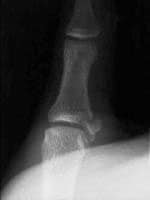
http://img.medscape.com/pi/emed/ckb/sports_medicine/84611-97564-98460-1652013.jpg
Consider imaging before stress testing (to avoid further displacing a fracture)
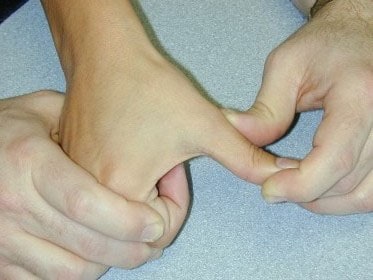
http://img.medscape.com/pi/emed/ckb/sports_medicine/84611-97564-98460-1652060.jpg
Stabilize in a thumb spica splint and refer to hand surgery.
Calling this entity a “simple sprain” may result in chronic disability (chronic pain, instability, loss of pinch strength)
Show References
Pain Control in the Elderly
- Narcotic pain relievers are often avoided in the elderly due to the concern of sedation, risk of falls and the concern of them causing delirium.
- Delirium can cause significant morbidity and mortality and can be difficult to differentiate between the sedation and mild confusion that often occurs with opioid dose escalation.
- However, delirium has been shown to occur more commonly as a result of the under treatment of pain rather than as an opioid adverse effect.
So the take home lesson for this pearl is that the elderly have a lower risk of delirium if their pain is treated appropriately.
Show References
Supraspinatus: “Empty can” test. Have the patient abduct the shoulders to 90 degrees in forward flexion with the thumbs pointing downward. The patient attempts to lift the arms against the examiner’s resistance.
http://bjsportmed.com/content/42/8/628/F2.large.jpg

Infraspinatus and teres minor: These muscles are responsible for external rotation of the shoulder. Have the patient flex both elbows to 90 degrees while the examiner provides resistance against external rotation.
http://www.physio-pedia.com/images/4/4b/Infraspinatus_test.jpg
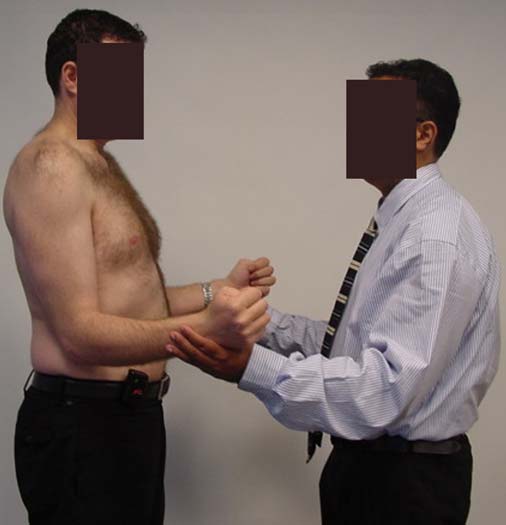
Subscapularis: “Lift-off” test. The patient rests the dorsum of the hand on the lower back (palm out) and then attempts to move the arm and hand off the back. Patients with tears may be unable to complete test due to pain.
http://www.aafp.org/afp/2008/0215/afp20080215p453-f4.jpg

Show References
Radiologic evaluation of the elbow (Part 2)
Helpful clues in the evaluation of elbow trauma:
- The Anterior humeral line and the Radiocapitellar line
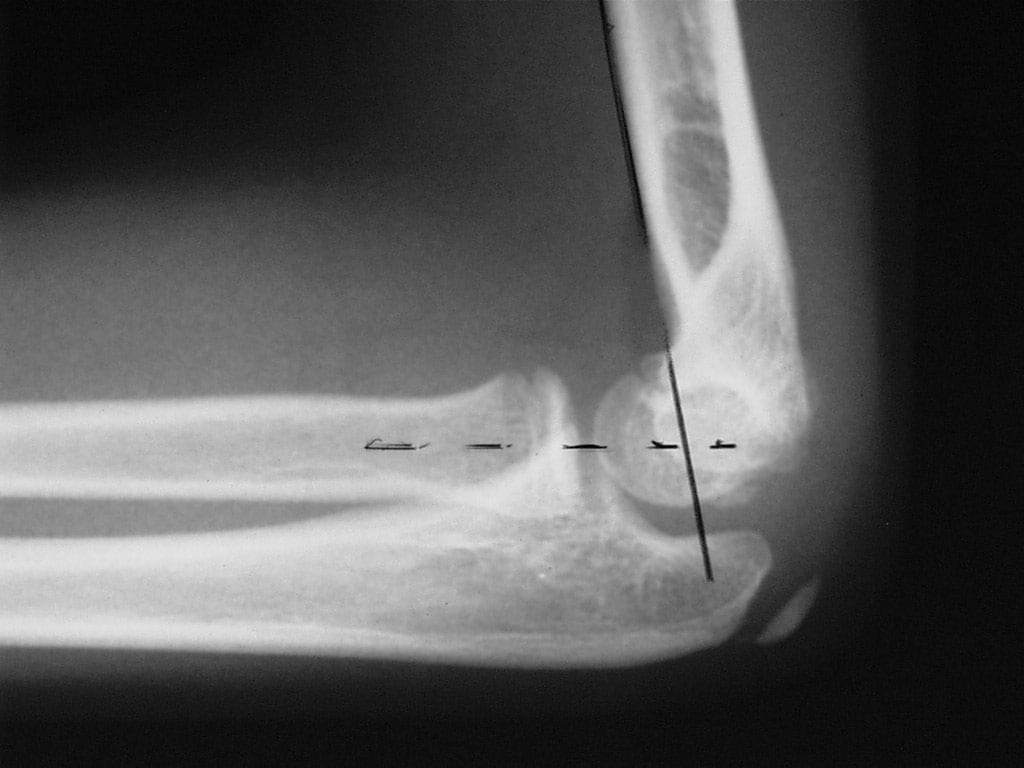
- The anterior humeral line: On a true lateral film, this line is drawn along the anterior aspect of the humeral shaft on the lateral radiograph This line passes through the middle one third of the capitellum in bones that are not injured. It is very useful for detecting subtle fractures.
- Fractures (i.e. supracondylar) usually result in displacement of the capitellum posteriorly.
- Thus, the anterior humeral line passes through the anterior one third or entirely anterior to the capitellum.
- The Radiocapitellar line: Since the radius articulates with the capitellum, a line is drawn through the middle of the radius shaft and extended proximally through the joint should bisect the capitellum on all views (AP & lateral).
- http://img.medscape.com/pi/emed/ckb/radiology/336139-415822-5412.jpg
- http://nypemergency.org/images/v2c18n.jpg
-
Improper alignment indicates a radial head dislocation (which may be very subtle)




Show References
Adhesive Capsulitis -- Frozen Shoulder
- Characterized by pain and loss of motion or stiffness in the shoulder.Normally not seen below the age of 40, affects ~2% of the population and diabetics are at increased risk.
- Due to thickening and contracture of the capsule surrounding the shoulder joint.
- Can occur after trauma to the shoulder if the shoulder is not moved early enough, but is also know to occur idiopathically.
- X-rays are only helpful to rule out other causes of the shoulder pain and are typically normal in Adhesive capsulitis.
- Typically will get better on its own over 2-3 years.
- Physical Therapy and home exercises aimed at restoring ROM can shorten the duration of pain and stiffness.
- Surgery can be done if there is no improvement with medical management and physical therapy.
- Prevention strategies include early ROM exercises in those with shoulder injuries especially in the elderly diabetic.
Show References
Rotator Cuff Tears:
Four muscles make up the rotator cuff (SITS) which control internal and external rotation of the shoulder and abduct the shoulder.
- Supraspinatus
- Infraspinatus
- Teres Minor
- Subscapularis
Tears can be due to acute injuries (falls, heavy lifting, forceful abduction), though the majority (>90%) of rotator cuff tears are chronic in nature and due to subacromial impingement and decreased blood supply to the tendons.
Most patients can be treated with sling immobilization, NSAIDs and referral to sports medicine or orthopaedic surgeons. Elderly patients should be referred quickly as prolonged immobilization can lead to a frozen shoulder.
Show References
Helpful clues in the evaluation of elbow trauma
Fat pads: The fat pad sign can be seen with any joint effusion (infection, inflammation) but in the setting of trauma, effusions are indicative of fractures about the elbow (even if no fracture line can be identified).
There are two fat pads within the elbow. Normally, on a true lateral radiograph only the anterior fat pad is seen as a small triangular radiolucent shadow anterior to the distal humeral diaphysis. The posterior fat pad is ordinarily not visualized on a lateral radiograph because it is tucked away within the olecranon fossa.
Normal lateral view: http://nypemergency.org/images/ElbowNormal.jpg

With fractures, the joint becomes distended with blood. The anterior fat pad becomes displaced superiorly and outward from the humerus giving the so called "sail sign." Similarly, the posterior fat pad gets displaced out of the olecranon fossa and becomes visible on the lateral radiograph.
Anterior (sail) and posterior fat signs: http://nypemergency.org/images/Elbowsfatpadarrow.jpg

Show References
Some common injuries and their board review associated complications
- Anterior Shoulder Dislocation = Axillary nerve or artery injury
- Supracondylar Fracture = Brachial Artery injury
- Posterior Elbow Dislocation = Brachial Artery injury
- Knee Dislocation = Popiteal Artery Injury and Peroneal and tibial nerve injury
- Humeral shaft fracture = radial nerve injury
- Posterior hip dislocation = sciatica nerve injury
- Anterior hip dislocation = femoral nerve injury
Show References
- Back pain is the most common musculoskeletal complaint that results in visits to the ED.
- It has a benign course in more than 90% of patients, so we must be vigilant and comfortable looking for warning signs of a neurologically impairing or life-threatening cause.
- We rely on the presence of so-called "red flags" or alarm symptoms to guide further diagnostic tests, specialty evaluation, and treatment.
- Additionally, always consider 2 important extra-spinal causes of back pain: aortic dissection (sudden onset back pain) and abdominal aortic aneurysm (patients >50, esp. those who you think have a kidney stone- isolated back and groin pain is a common presentation).
| History and Physical Examination Red Flags | |
| Historical Red Flags | Physcial Red Flags |
| Age under 18 or over 50 Pain lasting more than 6 weeks History of cancer Fever and chills Night sweats, unexplained weight loss Recent bacterial infection Unremitting pain despite rest and analgesics Night pain Intravenous drug users, immunocompromised Major trauma Minor trauma in the elder | Fever Writhing in pain Bowel or bladder incontinence Saddle anesthesia Decreased or absent anal sphincter tone erianal or perineal sensory loss Severe or progressive neurologic defect Major motor weakness |
The Salter Harris Classification System is used in pediatric epiphyseal fractures. The higher the type of fracture the poorer the prognosis
Some common exam facts about Salter Harris Fractures are:
- The type II fracture is the most common.
- The small metaphyseal fragment in Salter Harris type II and IV fractures is called the Thurston Holland Sign.
- Type III and IV fractures often require open reduction and internal fracture due to the fracture extending into the joint.
- Type V fractures may appear normal, but the epiphyseal plate is crushed and the blood supply is interrupted.
The Classification system as listed by Type:
- Type I: A fracture through the physeal growth plate. Typically can not be seen on x-ray unless they growth plate is widened.
- Type II: A fracture through the physeal growth plate and metaphysis.
- Type III: A fracture through the physeal growth plate and epiphysis.
- Type IV: A fracture through the physis, physeal growth plate and metaphysis.
- Type V: A crush injury of the physeal growth plate.
A image of the fractures can be found on FP Notebook at http://www.fpnotebook.com/_media/OrthoFractureSalterHarris.jpg
Show References
- Spondylolysis is a unilateral or bilateral defect in the pars interarticularis portion of the vertebrae.
- It is a stress fracture mostly seen in the lumbar vertebrae, and most commonly L5.
- Pain is relieved with rest and worsened by lateral bending or extension (NOTE: most back pain is worsened by flexion).
- If neurologic symptoms and/or radiculopathy are present, an alternative diagnosis should be considered, because they are rarely associated with spondylolysis.
- Diagnostic imaging should start with plain radiographs with added oblique views.
- Classically, oblique views show the Scotty dog sign with a crack on the dog’s neck/collar, the pars.
http://www.gentili.net/signs/images/400/spinescottyparsdefectdrawing.JPG
The Scotty dog’s head (superior articular facet), nose (transverse process), eye (pedicle), neck (pars interarticularis), and body (lamina) should be easily identified on the oblique radiograph.
Show References
Odontoid Fractures:
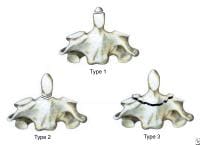
There are three types of C2 odontoid fractures:
- Type I is an oblique fracture through the upper part of the odontoid process. This fracture is normailly stable and can be treated with a hard cervical collar.
- Type II is a fracture occurring at the base of the odontoid as it attaches to the body of C2. These fractures can be treated surgically, or conservatively with hard collar or a halo brace
- Type III fractures occurs when the fracture line extends through the body of the axis. These fractures are normally treated surgically with or without a halo brace.
Show References
Calcaneus Fractures:
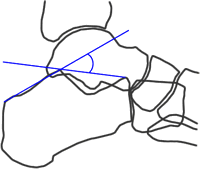
Calcaneus fractures can easily be missed on plain films and the true extent of the injury might not be appreciated until a CT is done. However, you can increase your change of picking up a calcaneal fracture by evaluating Bohler's Angle.
Lateral radiographs of the foot are needed to evaluate the Bohler angle. This is the angle made by drawing a line from anterior process of the calcaneus to the peak of the posterior articular surface and a second one drawn from the peak of the posterior articular surface to the peak of the posterior tuberosity. (See Picture) The average angle is 25-40°. Angles less than 25' are strongly suggestive of a fracture and the patient should probably get a CT of their foot if there is clinical suspicion.