
Congratulations to Katia Kontrogianni on her appointment as an American Heart Association Fellow!
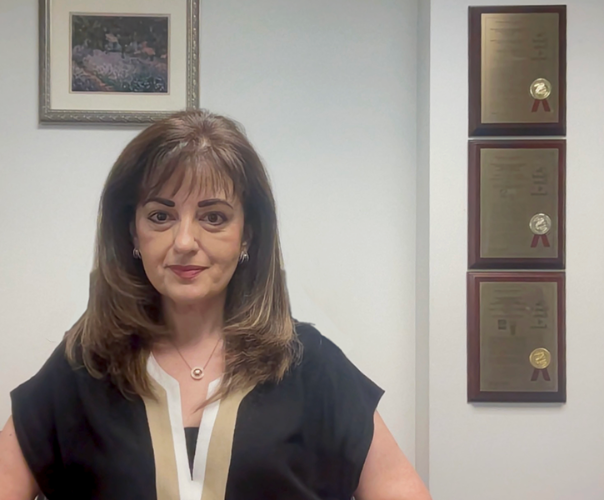
Dr. Aikaterini Kontrogianni-Konstantopoulos (pictured left) received her PhD from Baylor College of Medicine in Cell Biology. After completing her postdoctoral training at Johns Hopkins University School of Medicine in the Dept. of Medicine, she advanced her expertise in striated muscle pathobiology as an Academic Fellow in the Dept. of Physiology at the University of Maryland School of Medicine (UMSOM). In 2007, she joined the Dept. of Biochemistry and Molecular Biology at the UMSOM as Assistant Professor and was promoted to Professor in 2017. Using the muscle and breast epithelial cells, her laboratory has pioneered the molecular and functional characterization of major cytoskeletal proteins in health and disease, ranging from cardiac and skeletal myopathies to breast cancer. Her group is well known for its seminal contributions in the understanding of the complex, gigantic, cytoskeletal protein obscurin as structural and signaling mediator in the heart and breast epithelium and the essential, multifaceted Myosin Binding Protein-C slow in maintaining skeletal muscle integrity and regulating contractility.
Her latest work in cardiac muscle explores three primary areas: (i) the novel roles of obscurin in maintaining atrial structure/function, while examining its involvement in atrial fibrillation and remodeling when mutated or truncated; (ii) the pathophysiological relevance of the newly identified obscurin-kinase-1/N-cadherin axis in contributing to the electrochemical coupling of cardiomyocytes and thus the synchronous beating of the heart; and (iii) the sex-dimorphic manifestation of heart disease, focusing on the intricate interplay of estrogen as cardioprotective and testosterone as exacerbating factors. Her seminal findings have been published in a series of manuscripts, which have appeared in leading journals, including Science Advances, Basic Research in Cardiology, Journal of Clinical Investigation Insight etc. Notably, her team recently contributed an outstanding “In Depth review” in the leading cardiovascular journal Circulation, titled “Sex chromosomes and sex hormones: dissecting the forces that differentiate female and male hearts”.
Her research has been continually funded by the American Heart Association (AHA), the Muscular Dystrophy Association (MDA), and the National Institutes of Health (NIH). Dr. Kontrogianni-Konstantopoulos has received several honors, including the prestigious 2018 UMB “Dr. Patricia Sokolove Outstanding Mentor” award, the 2023 “GPLS Teacher of the Year” award as well as “Teaching Commendation” awards for her contributions in medical school instruction. This year she was elected as a Fellow of the American Heart Association (FAHA) conferred by the AHA Council on Basic Cardiovascular Sciences (BCVS). This “fellowship recognizes and awards premium professional members for excellence, innovative and sustained contributions in the areas of scholarship, practice and/or education, and volunteer service within the AHA/ASA”.
As Dr. Kontrogianni-Konstantopoulos stated: “For the past two decades, I have had the great opportunity and pleasure to volunteer my professional services to the AHA, an experience that has profoundly shaped and enriched my academic journey. In addition to benefiting from funding support early on through the Grant-In-Aid and recently through the Transformational Award mechanism, my relationship with AHA transcends funding; it’s about forging everlasting bonds with colleagues who share a unified goal of advancing AHA's mission “…to be a relentless force for a world of longer, healthier lives. As we move into the second century of our work, we are advancing health and hope for everyone, everywhere.” AHA has always felt like a true "home" to me, where I have eagerly embraced opportunities to learn, collaborate, volunteer, and contribute. This organization creates an environment where I am consistently welcomed, valued, and inspired to do my best. My recent election as FAHA is a distinguished honor and privilege, which further bolsters my resolve to combat heart disease through multidisciplinary, open-minded, and transparent research, mentor the next generation of cardiovascular scientists, and improve the quality of life for all.”