
Mini-Med School
ATTENTION MINI-MED SCHOOL PARTICIPANTS:
Please note that we are working on bringing the Mini-Med School program back soon in an even better format. More information will be coming. In the meantime, sign up to our mailing list and tell us what topics you are interested in learning about.
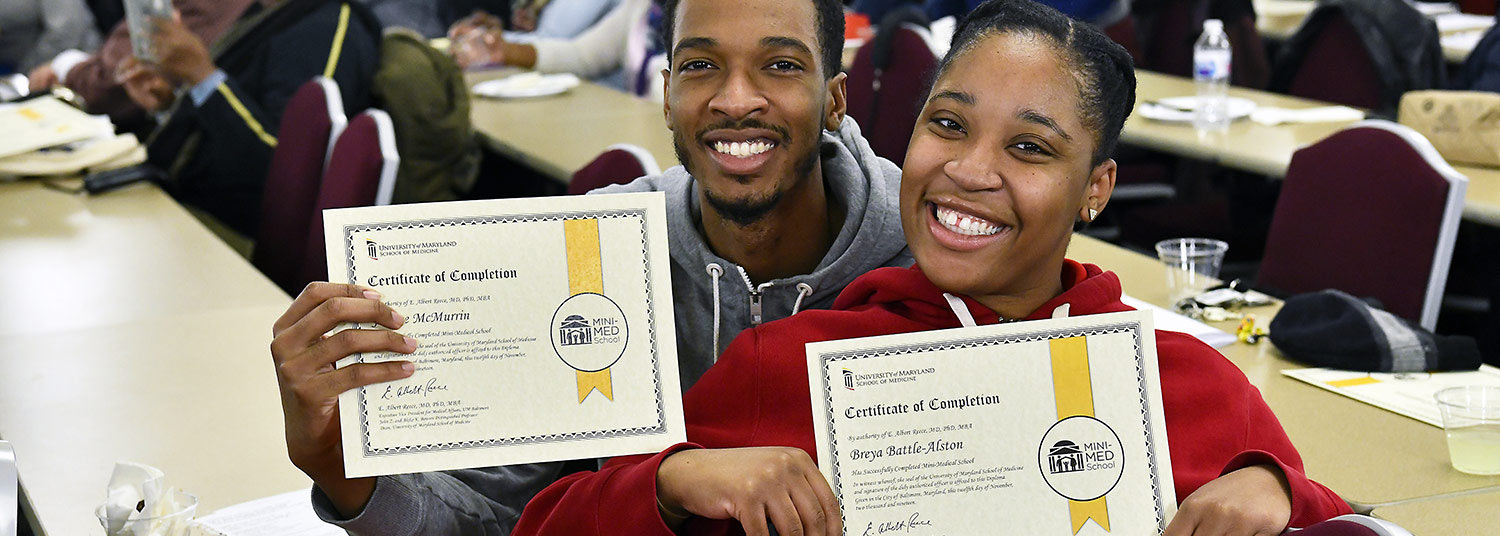
Offered as a public service, Mini-Medical School ("Mini-Med School") is a tuition-free lecture series provided by University of Maryland School of Medicine faculty, during which the lay public learns about diseases and their prevention.
The program began 18 years ago with a session for adults and has now expanded to adult seniors and local city youth.
Over 8,000 local community members have participated in the Mini-Med School Program!
Watch the Video:
JAQUES Initiative
The JACQUES Initiative, part of the Institute of Human Virology at the University of Maryland School of Medicine, provides HIV and Hepatitis C testing, education, prevention, and support. Through community outreach, it connects individuals to care and offers comprehensive support services.
The program has trained over 3,000 health profession students on AIDS and conducted more than 60,000 HIV and Hepatitis C testing encounters for patients.
 Health and Recovery Program
The Health and Recovery Practice (HARP) is a collaboration between University of Maryland partners focused on improving the health of people who use or have used drugs. The program provides screenings and support for mental health, chronic conditions, and infectious diseases, using a patient-centered approach.
School Mental Health
The School Mental Health team partners with 25 Baltimore City schools to help students thrive. Their work focuses on removing obstacles to learning, creating safe and supportive environments, delivering culturally responsive prevention and therapy services, and promoting overall wellness and academic achievement.
Programs of Assertive Community Treatment (PACT)
Assertive Community Treatment programs serve both adults and children who face severe challenges that prevent them from using traditional outpatient clinical services. These programs deliver intensive, personalized care designed to meet complex needs and support recovery in the community.